A business website can be doing more for your business than you realise.
Many small business owners measure their website's success by one thing: how many enquiries arrive through the contact form. If the form is quiet, it is easy to assume the website is not generating any business.
But contact forms are only one way people get in touch. Some visitors prefer to call, others send an email, and some use the website to learn about your business before contacting you another way.
The question is not simply whether your website receives enquiries.
The more useful question is: how do you know what your website is contributing to your business?
Your contact form is only part of the picture
Think about how people contact businesses today.
Someone searching for a local electrician might find the business on Google, visit the website to check the services offered, and then call directly from their mobile phone.
Another visitor might click an email address or an online booking button.
Someone else might have been referred by a friend and visit the website to check the business before making contact.
None of these visitors necessarily completes a contact form.
Yet the website may have played an important role in helping them decide to get in touch.
This is why counting contact form submissions alone does not give you a complete picture of website performance.
What counts as a website conversion?
In digital marketing, a conversion is an action that matters to your business.
For an online store, that might be a completed purchase.
For a service-based business, it could be an enquiry, appointment booking or request for a quote.
Other actions can also indicate that someone is interested in becoming a customer.
For example:
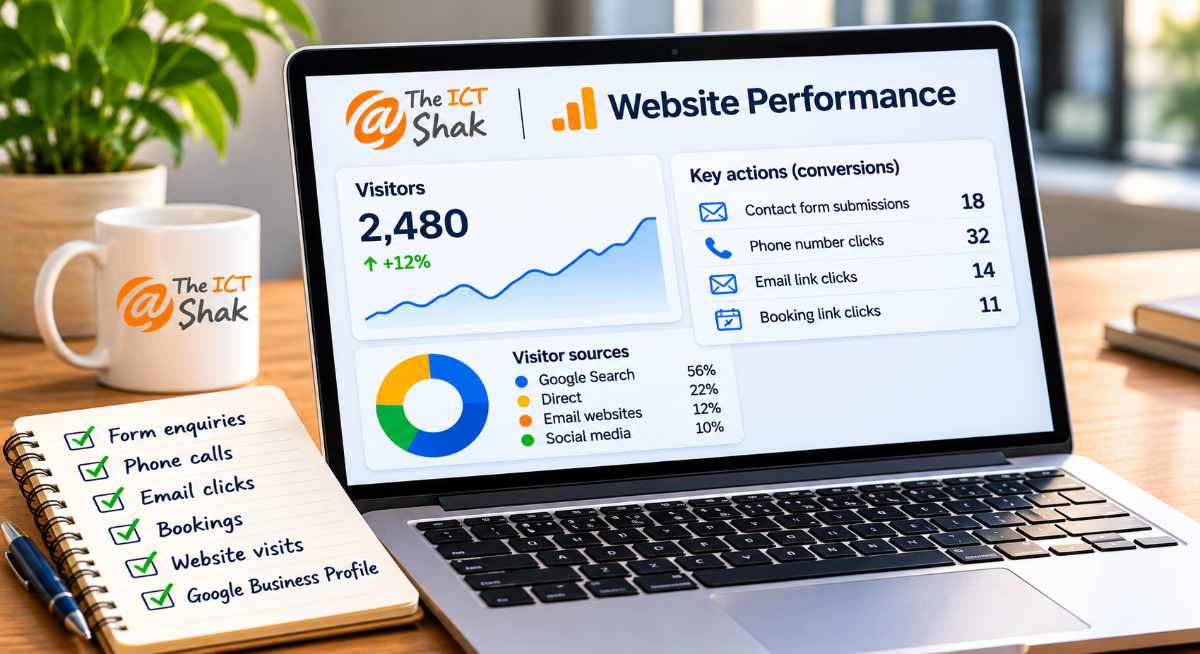
- Contact form submissions: Someone sends an enquiry through the website.
- Phone number clicks: A visitor taps your phone number to initiate a call.
- Email link clicks: Someone selects your email address to contact you.
- Booking button clicks: A visitor moves towards scheduling an appointment.
- Quote request clicks: Someone starts the process of requesting a quote.
- External booking or enquiry links: A visitor moves from your website to another platform to contact you.
Not every action represents a completed enquiry.
For example, clicking a phone number does not guarantee that the person actually made or completed the call.
However, these interactions can help you understand how visitors are using your website and which actions may lead to business opportunities.
Google Analytics can measure more than website visitors
Google Analytics 4 (GA4) is a free tool that helps you understand how people find and interact with your website.
It can provide information such as:
- How many people visit your website.
- Where visitors come from, including Google Search, social media and other websites.
- Which pages attract visitors.
- How visitors engage with your content.
- Which configured events and important actions occur on your website.
With the appropriate setup, Google Analytics can also track interactions such as phone number clicks, email clicks, form submissions and booking button clicks.
These can be marked as key events so you can monitor the actions that matter most to your business.
Having Google Analytics installed does not mean everything is being tracked
This is an important distinction.
A website might have Google Analytics installed and be collecting visitor information, but that does not automatically mean all the relevant enquiries and conversions are being measured.
Some interactions are collected automatically, while others require additional configuration, testing or integration with other systems.
For example, tracking a visitor clicking a phone number is different from confirming that the call connected or resulted in a new customer.
For more accurate telephone enquiry reporting, a business may benefit from dedicated call tracking.
The right tracking setup depends on how your customers normally contact you and what you want to measure.
What about Google Search Console?
Google Search Console is another free Google tool, but it serves a different purpose from Google Analytics.
Search Console helps you understand how your website performs in Google's organic search results.
It can show:
- Search queries: The words and phrases people use when your website appears in Google Search.
- Impressions: How often your website appears in search results.
- Clicks: How many times people click through from those results.
- Average position: The average ranking position of your website for the reported searches.
- Indexing information: Whether Google can discover and index your website pages.
For example, your website might appear in Google Search hundreds of times for a particular service, but receive relatively few clicks.
That information could help you identify an opportunity to improve a page's title, description or content.
Alternatively, a page might attract visitors from relevant searches but generate few measurable enquiries. That could suggest an opportunity to review the page's calls to action or how easily visitors can contact you.
Google Search Console does not measure your completed website enquiries, but it helps you understand how people discover your website.
Google Analytics and Search Console work together
Think of the two tools as answering different questions.
Google Search Console: How are people finding your website through Google Search?
Google Analytics: What are people doing when they visit your website?
Used together, they provide a much better understanding of website performance.
Do not forget your Google Business Profile
For local businesses, your Google Business Profile can be another important source of enquiries.
Someone searching for a nearby business might see your profile in Google Search or Google Maps and contact you without visiting your website at all.
Depending on the available features, customers may be able to:
- Call your business directly.
- Visit your website.
- Request directions.
- Use available booking or contact options.
Google Business Profile performance reporting can provide useful information about some of these interactions.
However, those actions are not automatically the same as conversions recorded in Google Analytics.
For a local business, it is worth reviewing both website performance and Google Business Profile activity rather than relying on just one source of information.
Your website also helps build trust
Not every valuable website visit results in an action that can be tracked.
Consider what happens when someone recommends a business to a friend.
The prospective customer might search for the business online, visit its website, read about its services and check whether it looks professional and established.
They may look for testimonials, examples of previous work, contact details or information about the people behind the business.
After that, they might call using the number supplied by their friend.
The website has helped reassure them that the business is worth contacting, even though no form submission or tracked phone click occurred.
This is particularly relevant for service-based businesses, where customers often want to feel confident before making an enquiry.
A website is not only a lead generation tool. It is also part of how people assess your credibility.
While Analytics can help measure visitor activity, it cannot reliably measure every impression, recommendation or decision influenced by your website.
Are you measuring the right things?
Before deciding that your website is not generating business, consider a few questions.
1. How do customers usually contact you?
Do most people call, email, book online or complete a form?
Your tracking should reflect how your customers actually behave.
2. Do you have access to Google Analytics and Search Console?
These tools may already be installed on your website.
If you have had your website for several years or worked with different website providers, it is worth checking what is already configured and who has access.
3. Are important interactions being measured?
Having Google Analytics installed is a good starting point.
But are phone clicks, enquiry forms, booking links and other meaningful actions being tracked correctly?
4. Are you reviewing your Google Business Profile performance?
For many local businesses, Google Business Profile is an important part of how customers find and contact them.
5. Do you ask new customers how they found you?
Sometimes the simplest way to understand where business comes from is to ask.
A customer might say they found you on Google, were referred by a friend, or had been looking at your website for some time.
Recording this information in your CRM or customer management system can help fill some of the gaps that online tracking cannot capture.
What should be included when a website is built?
At The ICT Shak, we include the basic setup of Google Analytics and Google Search Console when building a new website, and we explain these tools as part of the website handover.
This gives business owners access to valuable information about their website's visitors and search performance. More detailed conversion tracking is a separate level of setup.
Depending on the business, this might include configuring and testing enquiry form events, phone clicks, booking interactions, advertising conversions or integrations with a CRM. We undertake this additional work when specifically engaged to do so, or as part of relevant SEO and Google Ads management services.
The aim is to measure the actions that are meaningful to the business, rather than simply collecting data for the sake of it.
Before deciding your website is not working, look at the bigger picture
A quiet contact form does not necessarily mean your website is failing. Your website might be helping people discover your business, encouraging them to call, supporting your Google Business Profile visibility or giving referred customers the confidence to contact you.
Some of those contributions can be measured. Others are more difficult to attribute directly. The important thing is to understand what you are tracking, what you are not tracking and what the available information is actually telling you.
Before deciding that your website is not generating leads, make sure you are measuring more than just contact form submissions.
If you are unsure whether Google Analytics, Search Console or conversion tracking is configured correctly on your website, The ICT Shak can help you review what is in place and identify which measurements would be useful for your business.